'/%3e%3cg%20id='Rectangle%2013'%3e%3cpath%20id='Vector'%20d='M0%2022.4779L13.125%2015.0442L26.25%2022.4779L13.125%2030L0%2022.4779Z'%20fill='url(%23paint1_linear_843_9166)'/%3e%3cpath%20id='Vector_2'%20d='M0%2022.4779L13.125%2015.0442L26.25%2022.4779L13.125%2030L0%2022.4779Z'%20fill='var(--fill-0,%20black)'%20fill-opacity='0.4'/%3e%3c/g%3e%3cpath%20id='Rectangle%2014'%20d='M26.25%207.43366L13.125%200V15.0443L26.25%2022.4779V7.43366Z'%20fill='url(%23paint2_linear_843_9166)'/%3e%3cpath%20id='Rectangle%2015'%20d='M0%207.43365L13.125%2014.9558V30L0%207.43365Z'%20fill='url(%23paint3_linear_843_9166)'/%3e%3cpath%20id='Rectangle%2016'%20d='M26.25%207.43365L13.125%2014.9557V30L26.25%207.43365Z'%20fill='var(--fill-0,%20%23FDFDFD)'/%3e%3cpath%20id='Rectangle%2017'%20opacity='0.3'%20d='M0%207.43366L13.125%200L26.25%207.43366L13.125%2014.9558L0%207.43366Z'%20fill='url(%23paint4_linear_843_9166)'/%3e%3c/g%3e%3cdefs%3e%3clinearGradient%20id='paint0_linear_843_9166'%20x1='13.125'%20y1='11.2389'%20x2='0'%20y2='11.2389'%20gradientUnits='userSpaceOnUse'%3e%3cstop%20stop-color='%233B1784'/%3e%3cstop%20offset='1'%20stop-color='%23592BB5'/%3e%3c/linearGradient%3e%3clinearGradient%20id='paint1_linear_843_9166'%20x1='0'%20y1='22.5221'%20x2='26.25'%20y2='22.5221'%20gradientUnits='userSpaceOnUse'%3e%3cstop%20stop-color='%237849E7'/%3e%3cstop%20offset='1'%20stop-color='%234D27A5'/%3e%3c/linearGradient%3e%3clinearGradient%20id='paint2_linear_843_9166'%20x1='26.25'%20y1='11.2389'%20x2='13.125'%20y2='11.2389'%20gradientUnits='userSpaceOnUse'%3e%3cstop%20stop-color='%236949E7'/%3e%3cstop%20offset='1'%20stop-color='%234D27A5'/%3e%3c/linearGradient%3e%3clinearGradient%20id='paint3_linear_843_9166'%20x1='13.125'%20y1='18.7168'%20x2='0'%20y2='18.7168'%20gradientUnits='userSpaceOnUse'%3e%3cstop%20stop-color='%23DEDAE1'/%3e%3cstop%20offset='1'%20stop-color='white'/%3e%3c/linearGradient%3e%3clinearGradient%20id='paint4_linear_843_9166'%20x1='13.125'%20y1='0'%20x2='13.125'%20y2='14.9558'%20gradientUnits='userSpaceOnUse'%3e%3cstop%20stop-color='white'%20stop-opacity='0'/%3e%3cstop%20offset='1'%20stop-color='white'/%3e%3c/linearGradient%3e%3c/defs%3e%3c/svg%3e)
The wallet alert that exposed seven linked streamer accounts

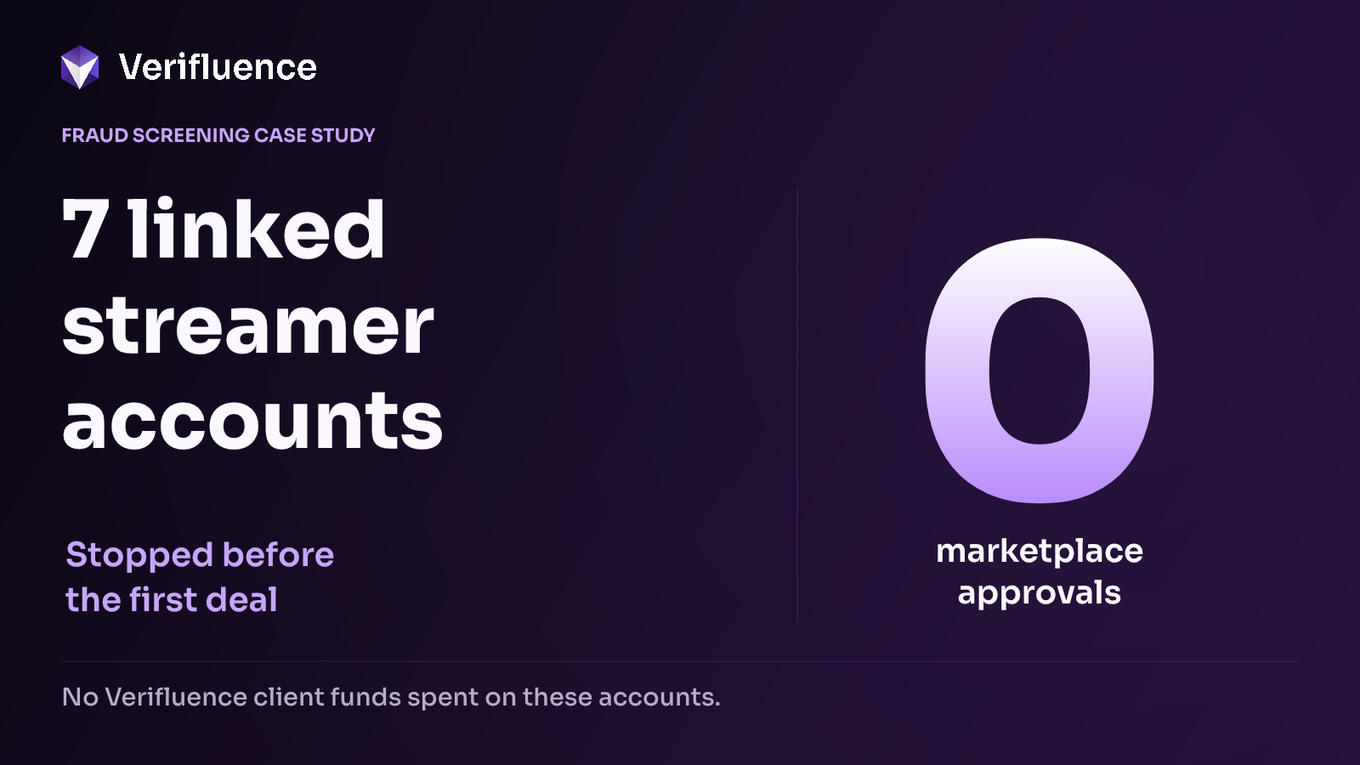
Passed KYC. Faces on camera. Convincing performance recordings. Here is why seven linked applicants still never reached the Verifluence marketplace.
The first warning was a payout wallet.
Two streamer accounts had entered exactly the same address. That connection started an investigation which ultimately linked seven applicants and led our team to identify a coordinated fraud attempt.
None of those seven accounts received marketplace access. No Verifluence client signed a deal with them or spent money on them through the platform.
We are sharing how the investigation unfolded because the applications were convincing. We are keeping the people and accounts anonymous because the useful part is the lesson, not a public naming exercise.
These were not obviously empty profiles
The applicants had completed KYC. They had linked social profiles and appeared on camera in streams. They also submitted recordings of their claimed results from previous casino partnerships.
These were full screen recordings, not a few cropped screenshots. They showed affiliate dashboards (mostly from Rainbet), with pages refreshing, wallet balances, hundreds of referrals and substantial wagering totals.
Viewed separately, the submissions appeared to support a credible track record. A real person, an active channel and a recording of past results can make a persuasive application.
But none of those things independently authenticates the performance figures on the screen.
Two accounts entered the same payout wallet
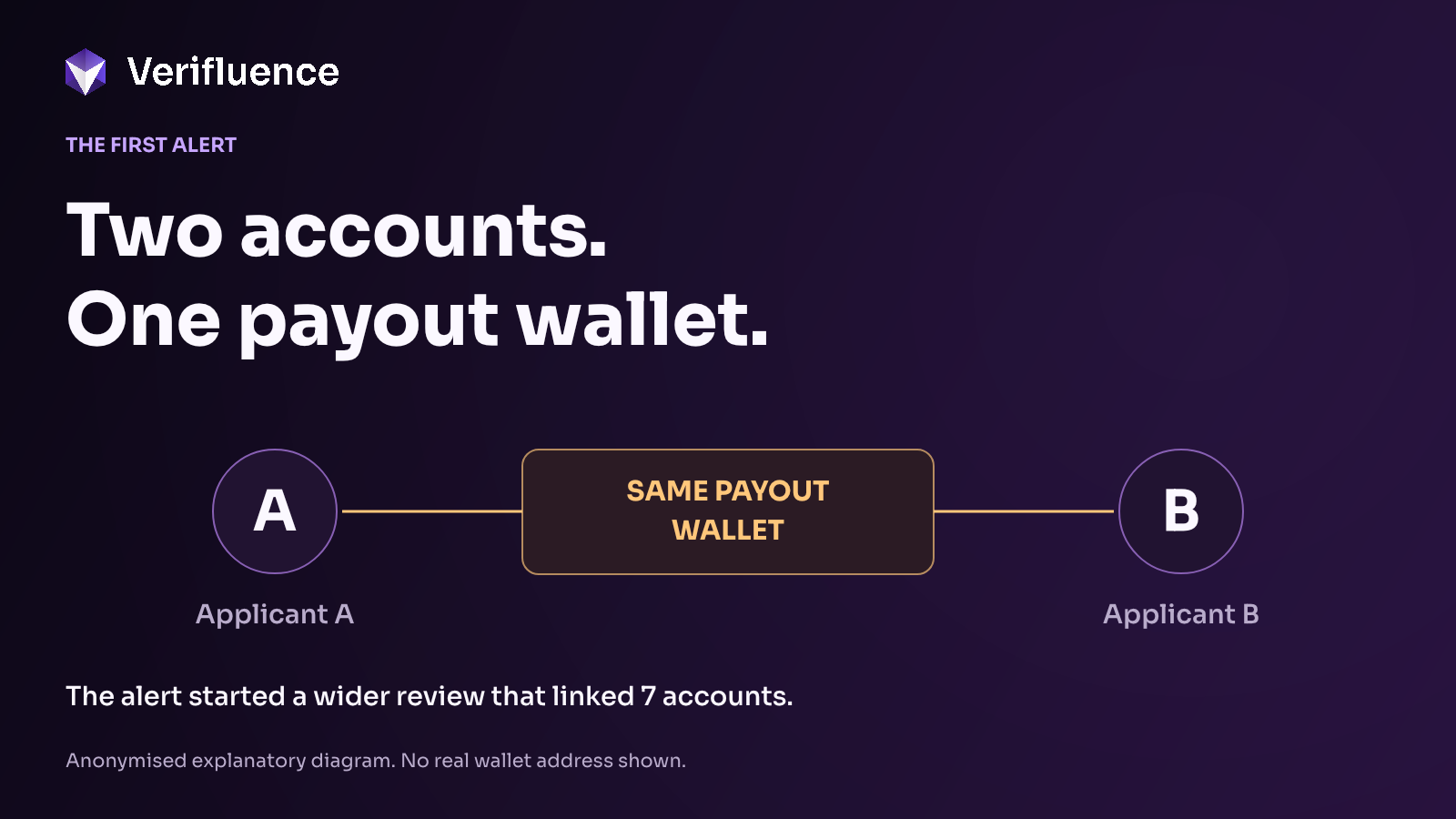
Our system flagged the shared address during onboarding.
A wallet connection is a reason to investigate. It does not, by itself, prove fraud or establish who controls an account.
We asked the applicants about it. The wallet details subsequently changed, and the applicants said they did not know how the overlap had happened.
That did not resolve the original connection. We started comparing the rest of their applications.
The recordings looked different when placed side by side
We noticed similar openings and recording sequences, often showing the same casino dashboards. That prompted us to widen the review to other recent applicants.
Across several submissions, we found repeated referral information, matching patterns in the displayed data and formatting inconsistencies. The similarities extended beyond people using the same streaming software or working with the same brand.
Recordings that looked plausible on their own became much harder to explain together.
We used AI-assisted comparison to help surface similarities for review. We did not treat an AI response as proof of fabrication. The decision rested on the combined application evidence and the connections our team investigated.
Our assessment was that several submissions contained fabricated performance evidence. We were looking at linked applications, rather than the independent track records they appeared to represent.
We checked the surrounding history too
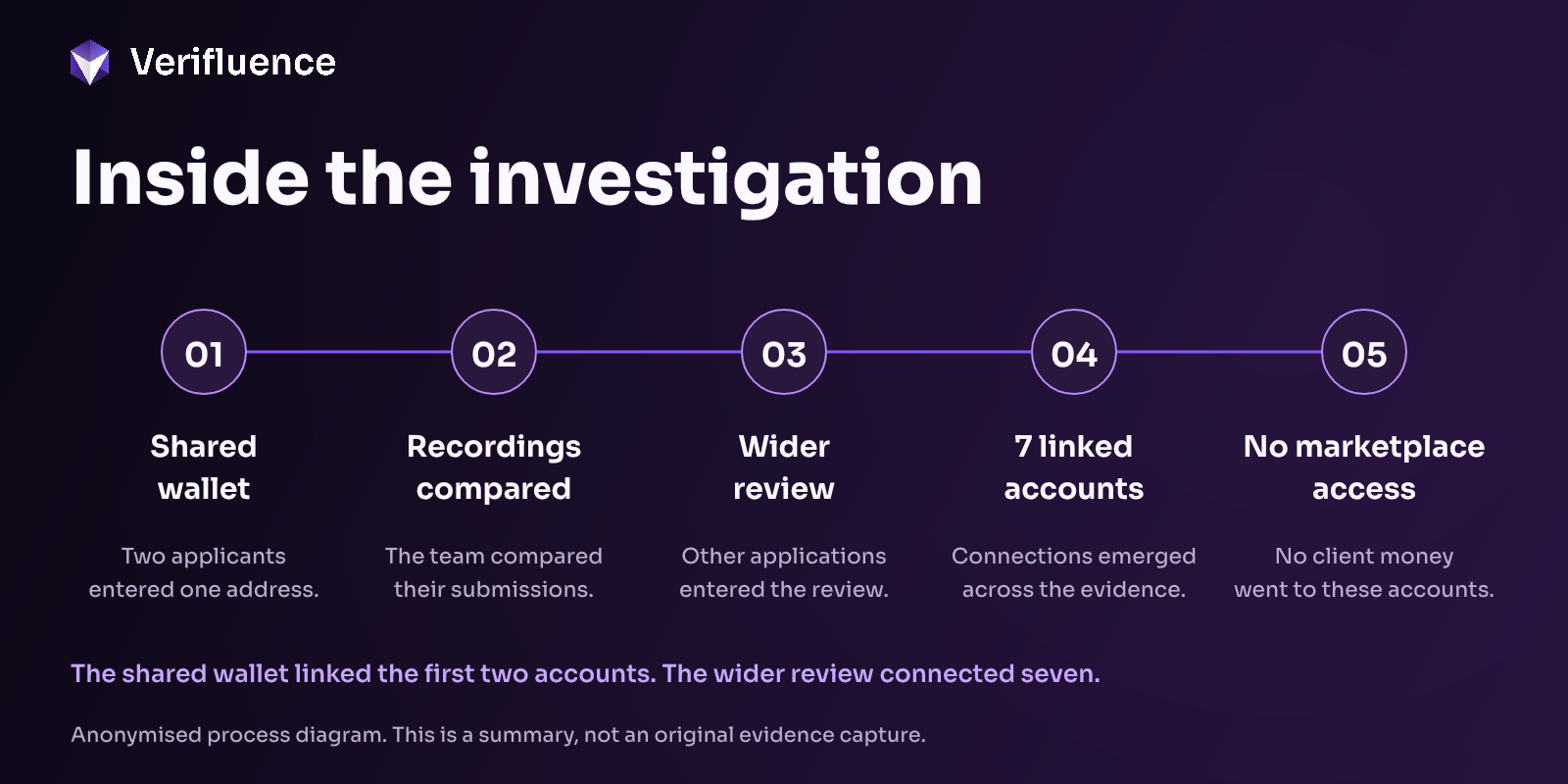
The wider review included the linked social accounts and past streams. Some social accounts were banned. Others had very little content. In some footage, the audio and visible lip movements did not line up.
Those details required context. A small social history or an audio-sync problem alone would not establish deception. We assessed them alongside the wallet connection and the inconsistencies across the submitted recordings.
By the end of the investigation, we had linked seven streamer accounts. That does not mean we can publicly establish how many people controlled them. What mattered for our review was whether their applications and claimed performance could be trusted.
The protection happened before the marketplace
Registering on Verifluence does not automatically unlock casino campaigns. Completing KYC is one part of the review, not the final approval.
The seven accounts never reached the marketplace. No Verifluence client funded a deal with them, and none received client payments through the platform.
This case ended at screening. We did not have to recover a client's money after a failed campaign.
For approved deals, escrow provides a separate layer of protection by tying payment releases to agreed delivery. It does not authenticate every historical claim or guarantee campaign results. Here, the important work happened before there was a deal to fund.
What casino teams can take from this
- Compare across applications. Reviewing each creator in isolation can hide connections that become visible when evidence sits side by side.
- Check where the numbers come from. A screen recording shows what appeared on a screen. Where possible, corroborate claimed results with the originating operator or platform through an authorised process.
- Investigate links in context. Shared details should trigger questions and a documented review, rather than an automatic conclusion about guilt.
- Keep verification and payment controls connected. Decide what evidence you need before approving a creator, agree delivery requirements clearly and use those requirements when reviewing payments.
An operator reviewing the last 30 streamer deals could start with a simple question: which performance claims did we verify independently, and which did we accept because the presentation looked convincing?
Genuine streamers benefit from this work too
Fabricated track records can compete for the same campaign budgets as creators building real communities. Screening protects the operators funding those campaigns and the genuine streamers who deserve a fair opportunity to win them.
The outcome in this case was straightforward: seven linked accounts, no marketplace access and no Verifluence client money spent on them.
That is why we keep looking beyond the application in front of us.
